

Inheritance litigation involves disputes over wills, trusts, and the distribution of a person’s estate. These cases may arise when there are concerns about the validity of a will, undue influence, executor misconduct, or disagreements among beneficiaries. Our role is to help clients understand their rights, investigate the circumstances surrounding the estate, and advocate for a fair and lawful resolution.

Probate Litigation
Is someone trying to deprive you of your rightful inheritance? Don’t let them get away with it! We are attorneys for heirs and beneficiaries. We specialize in the enforcement of inheritance rights. We’ll help you receive the inheritance your parents intended for you.
Our probate attorneys have many years of experience handling will contests and trust disputes in the Oakland County Probate Court and other probate courts throughout the State of Michigan. Our cases have involved disagreements among heirs, beneficiaries and family members over inheritances; wills and trusts that were improperly amended after a parent became mentally incapacitated or was unduly influenced; and breaches of fiduciary duties by personal representatives, executors and trustees.
Disputes among family members often arise after the death of a parent or grandparent. Our clients frequently find themselves in one the following situations:
- An heir or beneficiary has received Notice of a Probate Court proceeding and isn’t sure if or how to respond. If this is you, don’t ignore the Notice – your rights may be impaired or even lost if you don’t respond to the Notice on time. And don’t respond without the help an experienced probate attorney. Call us right away so we can make sure your rights are protected.
- An heir-at-law or beneficiary is being pressured to sign documents that may not be in his or her best interests. If you’re feeling pressured, please call us before signing anything! You could be signing away your rights.
- A stepmother has pressured a father to disinherit his children and leave everything to her. In this situation a son or daughter may have an “undue influence” or “mental incapacity” claim. If your father was mentally incompetent when he signed a new estate plan, or if he was coerced or tricked into disinheriting his children, his new estate plan could be invalid and you could be entitled to inherit under his previous estate plan.
- A brother or sister is attempting to subvert a parent’s true intentions by taking more than his or her fair share of the estate. We often see one sibling isolating an elderly parent from the others or abusing his or her authority as executor of the estate. You may need to file a Guardianship Petition to protect your parents or pursue a claim for undue influence or breach of fiduciary duty to preserve your inheritance rights.
- Whoever is in charge of an estate or trust is failing to provide the heirs and beneficiaries with financial information and cash distributions, or refusing to fairly divide a decedent’s personal property. You may have the right to compel accountings and distributions, and receive your fair share of your mother’s or father’s personal items of monetary and sentimental value.
- The trustee of a trust is denying a beneficiary’s request for a distribution of trust principal. Parents often leave it to a trustee’s discretion to decide when a trust beneficiary needs money from the trust. Retaining a high-powered probate court litigation firm is often essential. We have had great success convincing trustees to make requested trust distributions.
- Whoever is in charge of an estate or trust is paying themselves too much or making improper withdrawals or expenditures. Under these circumstances. you may have a breach of fiduciary duty claim to recover the misappropriated assets and remove the offending fiduciary.
In all of these situations we help heirs and beneficiaries inherit exactly what their parents wanted them to receive.
If you’re in a similar situation, we can help.
We always attempt to resolve inheritance disputes privately, confidentially and respectfully. However, if negotiations fail to produce an agreement, you will lose your inheritance rights if you don’t assert your rights as an heir or beneficiary in Probate Court. in these cases, you need an experienced hard-nosed probate litigation law firm. That’s us.
Our services include:
- Will Contests: A will contest is a probate court proceeding to establish or challenge the validity of a will or trust. In a will contest, an interested party such as an heir or beneficiary can seek to invalidate a will or trust, For example, a beneficiary under a prior will could contend that a more recent will was invalid because the deceased parent was the victim of undue influence by a beneficiary under the new will, or that the decedent was mentally incompetent when he or she signed the new will. If it is established to the probate court’s satisfaction that the more recent will is invalid, then the decedent’s estate will be distributed in accordance with the prior will. An improperly disinherited beneficiary can reestablish his or her inheritance rights by means of a will contest.
- Trust Disputes: A trust dispute is a probate court proceeding to enforce the rights of a trust beneficiary. Under 3 typical estate plan, a mother and father transfer their assets into a trust during their lifetime. Upon the death of the surviving parent, the remainder beneficiaries, usually the children, often become entitled to periodic income distributions. in addition, remainder beneficiaries may have the right to withdraw some or all of the principal of the trust, with or without the consent of the trustee(s). From time to time disputes arise between
the beneficiaries of a trust and the trustee(s). For example, a trustee might not be providing accountings or making distributions to the beneficiaries, or a trustee may be refusing to permit a beneficiary to withdraw principal from the trust, or a trustee may be favoring one beneficiary over the others (often him or herself). We represent trust beneficiaries in all kinds of trust disputes. - Undue Influence Claims: Unfortunately, far too often wills and trusts are signed not because they reflect a true change of intention, but because someone has been able to trick or pressure an elderly parent into disinheriting one or more children. A probate court proceeding alleging that a will or trust was the result of “undue influence” seeks to have the will or trust invalidated, The heir or beneficiary pursuing the undue influence claim has the burden of proving the new will or trust does not accurately reflect the decedent’s true intentions because the decedent did not act of his or her own volition. To do so, it may be necessary to offer the testimony of witnesses and friends who have personal knowledge of the decedent’s intentions, or of medical professionals regarding the decedent’s susceptibility to manipulation. If the probate court determines that a will or trust was signed as the result of undue influence, the will or trust will be invalidated and the decedent’s prior estate plan will be enforced.
- Mental Incapacity Claims: A mental incapacity claim may be pursued by an heir or beneficiary who believes a proffered will or trust was signed by the decedent when he or she was no longer mentally competent. The interested party pursuing this claim has the burden of proving that the decedent was not of sound mind and disposing memory when the questioned will or trust was signed, in many cases, testimony of doctors is submitted to the probate court to establish that a father or mother was suffering from Alzheimer’s disease or dementia when a will or trust was signed. If the probate court agrees, the will or trust will be invalidated and the decedent’s prior estate plan will be enforced.
- Hair-at-Law Claims: When someone passes away without a will, his or her assets pass to the “heirs-at-law” in accordance with the laws of intestate succession. Under Michigan intestate succession statutes, when a father dies without a will, his estate is shared between his surviving widow and children, it is often necessary for an heir-at-law to open a probate estate in order to enforce his or her right to inherit under the laws of intestate succession.
- Breach of Fiduciary Duty Claims: A fiduciary is a personal representative, executor or trustee. All fiduciaries are legally obligated to act in the best interests of the heirs and beneficiaries to whom their fiduciary duties are owed and strictly forbidden from acting in their own Interests. Fiduciaries are often also beneficiaries. For example, one sibling may be named as the fiduciary of a will or trust and entrusted by the parents to treat all of the siblings equally and fairly. If the entrusted sibling fails to do so, the other siblings may have a breach of
fiduciary claim. To prevail on a breach of fiduciary duty claim, an heir or beneficiary has the burden of proving that the fiduciary breached his or her duties by violating the terms of the will or trust, failing to abide by any probate court order or abusing his or her discretion regarding trust distributions. A beneficiary can assert their breach of fiduciary duty claim in probate court, seeking removal of the fiduciary and/or recovery of trust assets. misappropriated or imprudently invested by the fiduciary. The probate court could also seek to compel the fiduciary to take specific actions, such as make distributions to trust beneficiaries.
In The News
TRIAL OVER ARETHA FRANKLIN’S ESTATE GETS UNDERWAY
Queen of Soul’s sons begin public battle for her assets
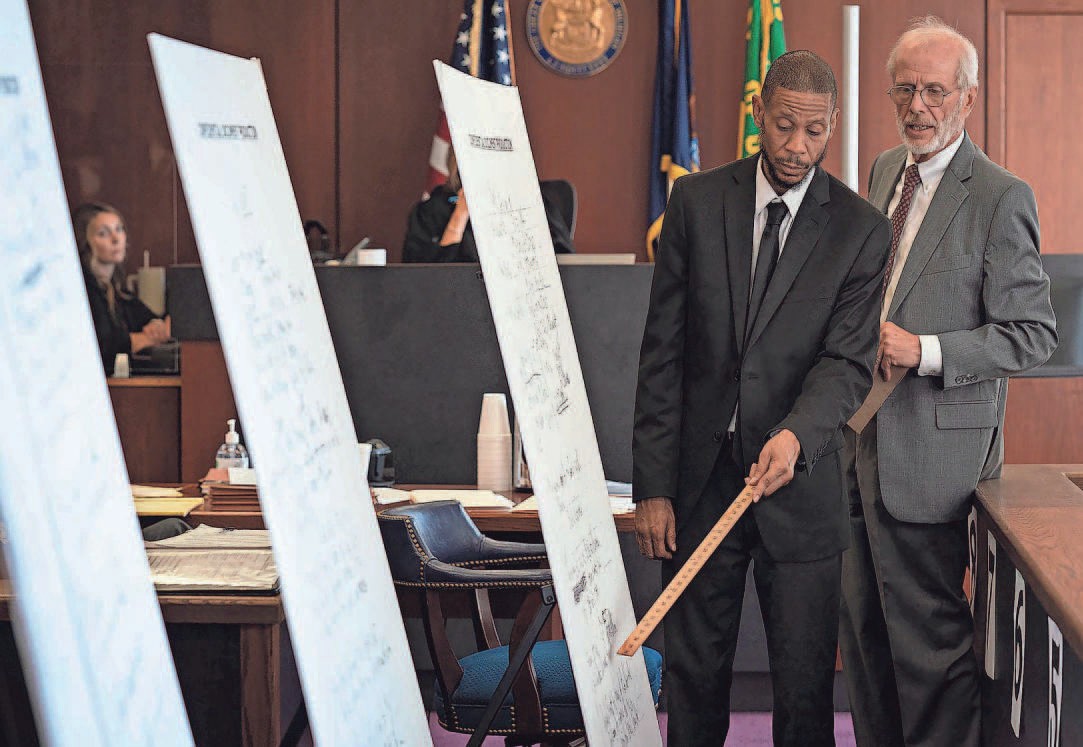
Kecalf Franklin, 53, youngest son of Aretha Franklin, points to enlarged documents at the direction of attorney Charles McKelvie during the first day of a jury trial over Aretha Franklin’s wills. PHOTOS BY SARAHBETH MANEY/DETROIT FREE PRESS
Judge Narrows Focus to 2014 Handwritten Document in Aretha Franklin Estate Trial
By Brian McCollum
Detroit Free Press USA TODAY NETWORK
Two of Aretha Franklin’s sons testified Monday before an Oakland County jury as a trial got underway to help settle the late star’s long-running estate saga.
Monday morning, ahead of the proceedings, probate court Judge Jennifer Callaghan tightened the parameters of the trial, which was originally expected to assess two documents handwritten by

A smiley face written with Aretha Franklin’s signature in 2014 is seen on a document displayed during the trial in Oakland County Probate Court in Pontiac on Monday.
Franklin in the years before her 2018 death.
Instead, the six-person jury will decide simply whether a four-page document written by Franklin in 2014 fits the criteria to be considered a will under Michigan law. Franklin’s sons have al- ready agreed that the other document, written and notarized in 2010, meets those requirements and qualifies as a will.
The trial in Oakland County Probate Court, which flared with tensions a couple of times Monday, will help determine the final wishes of one of the most towering figures in 20th-century music and culture. After five years of legal wrangling, combative court filings and bickering among brothers, the suburban Detroit jury trial, rare in probate matters, is a kind of grand finale. Still, Callaghan could be the one to make the ultimate ruling. That depends on the jury’s decision, which will either put two competing wills on the table or leave just one. The status of the March 31, 2014, document may come down to the Queen of Soul’s signature. It appears toward the bottom of the last page — although not at the very end — inscribed as “A. Franklin,” with a smiley face drawn inside that first initial. Franklin commonly signed her name that way. An exhibit produced in court Monday showed that same style of autograph embedded in cement at a Detroit museum.
Three of Franklin’s sons were in the courtroom Monday. Another son, Clarence Franklin, the eldest, has special needs and resides in an assisted-living home. An undisclosed agreement was reached among the other brothers ahead of the trial to provide his financial support. Also watching on Monday were Aretha Franklin’s grandchildren Jordan, 28, Victorie, 24, and Grace, 17.
Two of Franklin’s sons, Kecalf and Edward, are advocating for the 2014 document. Their attorneys argued Monday that the “A. Franklin” was clearly intended as a certifying signature. Because the document was also written and dated by Franklin, it thus qualifies as a will in Michigan, they argued.
“Edward believes this 2014 document represents her most current wishes … and thus should be honored,” his attorney, Craig Smith, said in an opening argument.
An attorney for Ted White II, a son who is pushing for the 2010 will to prevail, pointed out that the 2014 signature is followed by several more lines of text. White’s attorney contended the “A. Franklin” is merely a notation next to a line about a Bloomfield Township property the singer had sold to the Detroit Pistons’ Joe Dumars. White’s attorney also noted that in her 2010 will, Franklin marked all 11 pages with the distinctive signature. The 2014 document should be regarded simply as a draft or notes, he argued. Kecalf, who at 53 is the youngest of the sons, was first to testify. He spoke from the stand as four enlarged copies of the 2014 document were displayed for the jury.
In that document, Aretha Franklin wrote that Kecalf should get her main Bloomfield Hills home, “for him & my grandchildren.” Kecalf has two sons and two daughters. Kecalf said that when his mother died in August 2018, he was not aware of any existing will and assumed Franklin’s assets would be split evenly among the four brothers as dictated by Michigan law.
That would change months later. Sabrina Owens, a niece of Franklin, testified via deposition that she discovered both documents in May 2019 at the late singer’s house. Owens, then the estate’s executor, had gone there hoping to turn up anything to “get some direction” as Franklin’s estate was sorted out. Inside a cabinet, she found a key encased in bubble wrap, and she realized it opened a locked desk drawer near the foyer. There, alongside record contracts and other documents, she found the 11-page document from March 2010, along with an accompanying note dated that October. That same day, Owens said, she found the 2014 document under a couch cushion among three spiral notebooks containing Franklin’s doodles and personal notes. Kecalf testified that his mother spent a lot of time on that living room couch, handling business and even often sleeping there. He said the area was not tidy, with “a lot of papers around.”
Under cross-examination by his brother’s lawyer, Kecalf conceded Franklin did tend to store important papers at her desk, but that it “doesn’t strike me as odd” she would have stashed one in the couch.
Ted, a professional musician who worked with Franklin for 30 years as a touring guitarist, later took the stand, testifying that his mother undertook key documents “conventionally and legally,” often consulting with lawyers. The “freehand” 2014 document “was the first time I’d ever seen that,” he said.
A heated moment came during cross-examination, when Charlie McKelvie, an attorney for Kecalf, produced papers indicating that Ted has attempted to trademark his mother’s smiley-faced “A. Franklin” signature. The judge blocked that line of questioning after an objection by Ted’s lawyer.
Tensions flared again when Smith, the attorney for Edward, probed at Ted’s Florida residency, questioning whether he did regularly spend time with his mom. The judge also blocked that inquiry.
Following jury selection and a lunch break, the trial’s start was slightly delayed Monday when a juror who had sworn in sent a note to the judge asking to be dismissed. The reason was not made public, and the juror was replaced with an alternate.
The prevailing document will determine how Franklin’s estate — valued at $18 million shortly after her death — is apportioned among the sons and other potential heirs.
The 2010 will distributes her properties fairly evenly, calling for Ted and Kecalf to share ownership of the main Bloomfield Hills home, previously appraised at $1.1 million, while providing “a 1st class home” for Edward. It also asks that her jewelry, furs, furniture and music royalties be split evenly among the four sons. The 2014 document, in addition to willing the main house to Kecalf, calls for royalties and bank funds to be split among the three youngest sons.
A third, typed will document, prepared by a Troy law firm months before Franklin’s death and uncovered in 2019, was ruled out of consideration by Callaghan after an April hearing.
The ailing singer had never signed it and voicemail recordings indicated she sought changes to the draft that were not made. The April hearing had brought a dramatic scene as 20 minutes of those voicemails were played in court. Monday, the judge listened again to a two-minute section in which Franklin stated she revoked “any and all” previous wills. Ted White’s attorney sought to have it played for Monday’s jury, but the judge opted against it, saying she had already ruled the typed document had no standing. Closing arguments are scheduled to be heard Tuesday morning, with jury deliberations to begin afterward. Contact Detroit Free Press music writer Brian McCollum: 313-223-4450 or bmccollum@ freepress.com. F
Contact Detroit Free Press music writer Brian McCollum: 313-223-4450 or bmccollum@freepress.com.